RefCycle
Reducing Recycling Decision Friction Through Real-Time Product Guidance
Snapshot
Role: Product Discovery Lead
Team: 5 Designers
Duration: 4 Weeks
Tools: Figma · Miro
Focus: Translating qualitative research into prioritized product direction and MVP scope
The Problem
Sustainable intent was high. Recycling accuracy was not.
User research revealed that the primary barrier to proper recycling was not motivation, but uncertainty. Participants consistently expressed confusion around hard-to-recycle materials, inconsistent local rules, and fear of “doing it wrong.” This hesitation created friction at the point of disposal, often leading to landfill as the default choice.
This represented an opportunity to reduce friction at the moment of decision and increase sustainable behavior adoption through just-in-time product support.
Opportunity:
Design a product that reduces cognitive load and enables confident, habit-forming disposal behavior.
My Role
I led end-to-end discovery and translated qualitative insights into prioritized product direction and MVP scope decisions.
Specifically, I:
Designed and conducted user interviews and surveys to identify decision friction patterns
Synthesized findings into problem statements and facilitated feature prioritization using impact vs. effort mapping
Defined core MVP features, created mid- and high-fidelity prototypes, and led usability testing iterations
My focus was ensuring research directly informed product decisions rather than generating standalone insights.
Key Insights
Users lacked confidence in their recycling knowledge
Localized disposal rules created inconsistency and hesitation
Users wanted immediate answers at the moment of decision, not post-action education
These insights reframed the product from an educational platform to a real-time decision-support tool.

Product Direction & MVP Scope
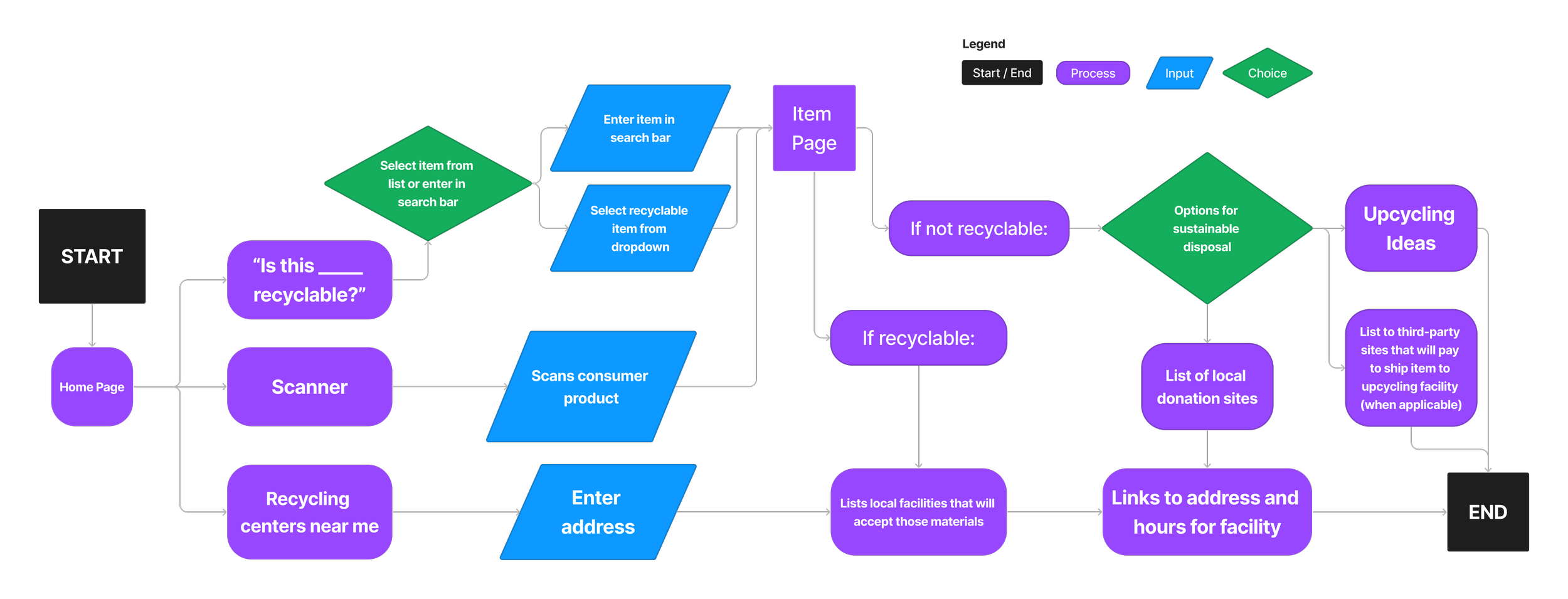
Instead of building a content-heavy sustainability app, we prioritized fast, contextual guidance.
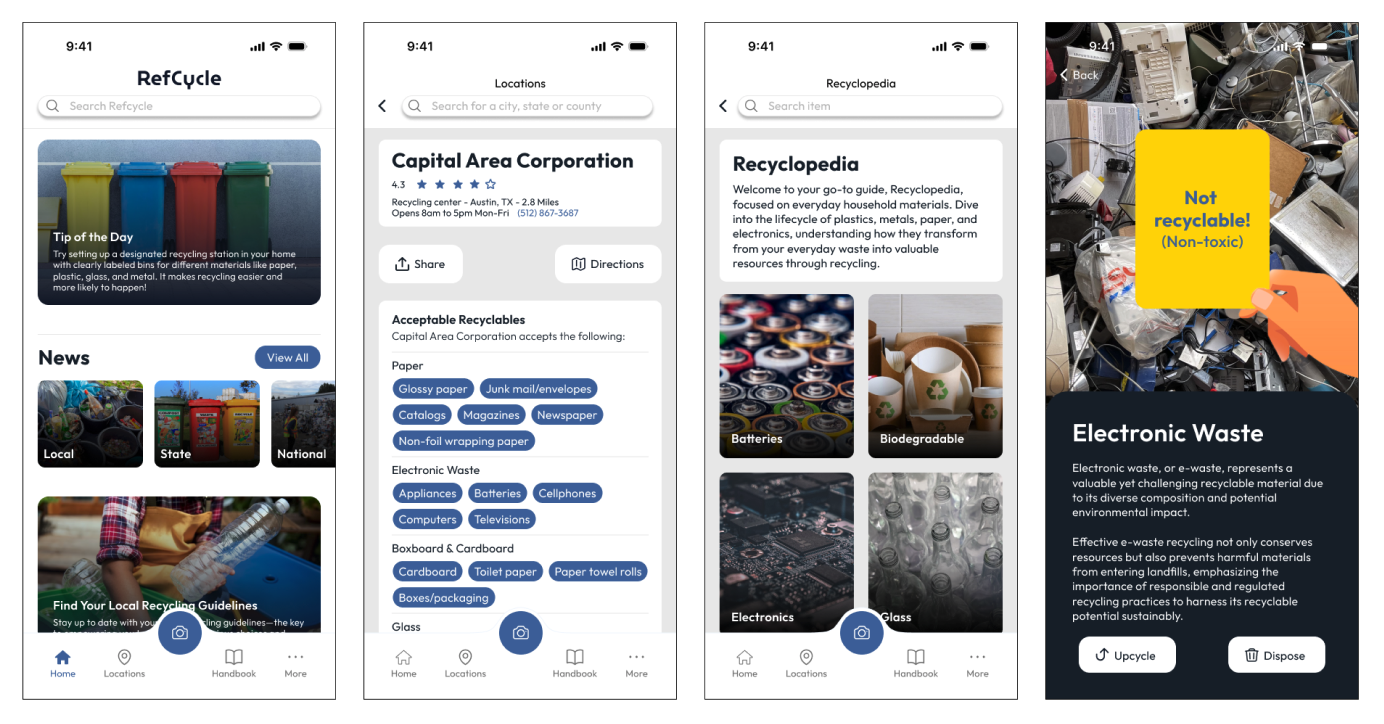
Core MVP Features
Item Identification Scanner
Enables rapid material classification to reduce hesitation.
Searchable “Recyclopedia”
Provides clear disposal guidance for common materials.
Localized Recycling Center Locator
Adds geographic context for non-standard items.
Upcycling Suggestions
Encourages alternative behaviors when recycling is not viable.
Tradeoffs & Prioritization Decisions
Deferred social and community features due to low validation signal
Reduced onboarding friction to minimize drop-off
Scoped MVP to high-frequency recycling scenarios to maximize immediate impact
We prioritized speed, clarity, and usability over gamification or feature breadth.
Validation & Iteration
We conducted usability testing across multiple prototype iterations to evaluate task success and decision clarity.
Outcomes included:
Majority task completion without assistance
Measurable reductions in lookup time between iterations
Increased user-reported confidence in disposal decisions
Testing reinforced that clarity and speed were more valuable than engagement mechanics.
Product Capabilities Demonstrated
Translating qualitative research into clear product strategy
Defining MVP scope based on validated user pain points
Making evidence-based tradeoffs under time constraints
Prioritizing feature sets aligned with measurable user outcomes
This discovery-to-prioritization workflow mirrors how I now gather, synthesize, and operationalize customer feedback within enterprise SaaS environments.